

The office of family-owned B2B media company Mark Allen Group is located in St Jude’s, a grand old neo-gothic stone church in leafy South London.
Mark Allen, the company’s eponymous founder and executive chairman, told A Media Operator he likes that the office choice sets MAG apart from other publishers.
“I don’t want to be like other companies.”
Saint Jude, if you were wondering, is the patron saint of lost causes—perhaps an apt dedication for a company that frequently scoops up old print journalism titles in disparate verticals at a time when the industry is moving both away from print and toward specialization. (It’s a joke Allen says he himself often makes.)
Mark Allen Group spans some 100 publications and 250 events, ranging from Farmers Weekly and classical music title Gramophone to Journal of Wound Care and Pig World. It has made around 30 acquisitions since its founding in 1985, hitting a particular intensity around the pandemic when Flashes & Flames described it as “Europe’s fastest-growing B2B media company.”
But that growth has stumbled recently. Revenue has continued to rise, hitting £72.1 million in its most recent accounts, covering the year to March 2025. EBITDA, though, has fallen each year since 2022—when it was £13.1 million (a 22% margin)—to £9.3 million (13%) in the most recent filings.
Notably, the company also saw a rare operating loss in 2025—in large part the result of the “disastrous” acquisition of financial services publisher Bonhill in 2023, Allen said. Its entire carrying value was written off in the 2025 accounts.
The accounts running to March 2026 will also look rough, Allen said. But thereafter, he thought, things will start looking up—thanks in part to a five-year plan, due for completion in 2029, that aims to get revenue to £100 million and EBITDA to no less than £17.7 million.
But doing so may require the company to get deeper into events and data—fields Allen readily accepts he is not as passionate about as the world of print publishing.
“I think the last three years, there’s no point in disguising it—we’ve been second division rather than Premier League,” Allen said. “And we now have to try and get back to Premier League again.”
Disaster
Allen pointed to several reasons for the company’s recent slowdown: many of the Mark Allen Group publications still run in print, the costs of which have gone up “exponentially,” he said. And the size of the staff has ballooned over the years, growing from 282 to 477 between 2016 and 2023 and adding a further 70 staff in the two years after that.
“We weren’t sharp enough, coming out of the pandemic, to act,” Allen said.
But the most dramatic weight on the 2025 balance sheet was Bonhill, which was written off at a cost of £5 million.
The group paid £6.5 million for Bonhill, which included titles like Portfolio Adviser, International Adviser and Fund Selector Asia. Allen was hesitant to discuss what exactly had gone wrong, but said market conditions had been unfavorable, that there had been a mismatch between the cultures of the two companies and that MAG had taken on “many more staff than we should have.”
There were 44 staff working at Bonhill when MAG acquired it, Allen said; there are 14 now. He added that the subsidiary is budgeted to make a profit this year—indeed, the entire Mark Allen Group has budgeted for revenue of £85 million in the 2026/27 financial year and EBITDA of £12 million, representing a margin of 14%. Allen said that so far this year the company has been consistently outperforming its monthly budget.
“If you asked me a year ago—I was slightly depressed about it,” Allen said. The Bonhill affair had “probably affected our confidence to some extent,” but more broadly “I could see that we hadn’t really cottoned on to facing the reality, and the truth.
“The hardest thing sometimes, when you’ve been doing seemingly quite well, is to get people to actually look at themselves and take stock of where they are… because we had been deemed to be very successful, I think that truth was quite painful.”
The most consequential thing the company has done to address the sluggishness is shrink the workforce through a mix of hiring freezes, internal redeployments and redundancies. (Allen stressed that, across the company’s history, it has made “very, very few redundancies.”)
The acquisition of the road portfolio of DVV Media International at the end of last year added 21 roles to the company; despite that, total headcount has fallen from around 550 to 500 over the past year.
The workforce is not yet “efficient or slim enough,” he added, “so I think there’s still more work to be done there,” he said. “But we’re in a much, much better shape than we were a year ago.”
Letting a Magazine Die Should be Punishable With ‘Execution’
The full roster of Mark Allen Group verticals include the following: agriculture, animal health, business, dentistry, education, engineering, events, finance, healthcare, manufacturing, music, real estate, technology, transport and travel retail.
Allen is well aware that his company’s presence in so many disparate areas is something of an oddity in modern B2B media, which tends to value depth over breadth.
That the company is set up this way is a result of historical necessity: MAG was originally a B2B healthcare publisher with little in the way of spare cash, and had to be “very opportunistic” in order to grow.
“We wouldn’t have been where we are if I had been waiting for Godot for the right kind of healthcare title.”
MAG grew in an era in which companies like RELX were undergoing their own transformations and exiting their traditional publishing operations, which meant Allen could buy them up at “very reasonable prices.”
The company’s acquisitions have all been financed through cash or bank debt; it hasn’t taken “a penny of extra investment,” he said. Across all the purchases Mark Allen Group has done, Allen said the average time it had taken to earn back the cost of acquisition was four years; the fastest was four or five months.
The criticism that MAG is spread thin “can be a bit over-exaggerated,” Allen said.
“I believe the skills in journalism, or publishing, are transferable. It’s not like we’re going from publishing into being rocket scientists—we’re going from one form of publishing into another form of publishing.”
There is another element to all the acquisitions, though: sentimentality.
“I don’t believe in closing magazines at all,” Allen said. “I hate closing them.”
“All the expertise, the thought, the energy, the activity, the nervous pressure that’s gone into building those magazines… and you allow those to die? That should be an execution crime, shouldn’t it? You should have a noose around you[r neck]!,” he laughed. “They’re part of our culture, part of our history!”
At the end of 2024 Allen acquired the storied real estate B2B publication Estates Gazette from RELX, which had been planning on closing the title outright.
Upon saving the brand Mark Allen Group changed the once “colossal” B2B magazine’s name back from “EG” to Estates Gazette, revamped the magazine and expanded its pagination, all with more of a view to driving subscriptions. Allen told AMO that, in its first year at MAG, the title made a gross profit of £854,000 ($1.1 million).
For Allen, Estates Gazette is a case study in what can be done with legacy titles if you properly invest in them and their content. Most magazines “are salvageable with the right team,” he said.
Most, but not all. In March Mark Allen Group closed Classical Music Magazine, air freight publication Air Logistics International and teachers’ mag Drama & Theatre.
“Sometimes you have to be honest and say that, even if it’s salvageable, it’s going to take an enormous amount of effort to turn it around.”
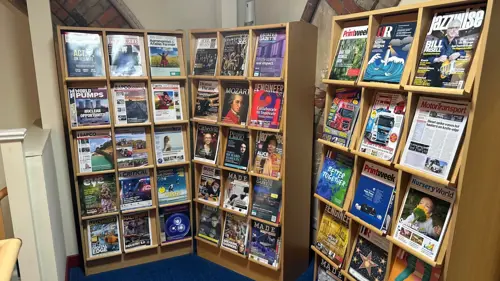
Newsstands in the Mark Allen Group church offices display a wide array of the company's titles, including Estates Gazette, Jazzwise, Critical Communications Today and Agronomist & Arable Farmer.
A newsstand in the Mark Allen Group office displays a wide range of the company’s print titles. Picture: Bron Maher – A Media Operator
The Path to £100 Million
Successfully completing the five-year plan will require Mark Allen Group both to make acquisitions and grow organically.
Prompted on what might drive the latter, Allen said he wanted to build “a proposition around newsletters.” A series of “very profitable podcasts” launched by Estates Gazette pointed another direction forward. “I’d like to see more new launch activity in agriculture and also in healthcare,” he said.
The business is also looking at ways it might build out data solutions. Its most successful at present is Mark Allen Online, a content library for all its clinical magazines that’s sold to institutions and libraries. But there are challenges to adding more.
At the moment “I don’t think we have had the right kind of staff to actually do that,” Allen said. The recent accounts refer to a goal of improving the skills mix within the business, which may have informed the May hiring of Anna Younger as COO; Allen said she has “much more of a digital data background.”
Then there’s conferences—a revenue stream that has driven the company’s revenue growth in recent years, and which overtook advertising as a revenue stream in the 2025 accounts.
Mark Allen Group’s events span awards, conferences, confexes, exhibitions and summits, taking in the likes of the British Journal of Nursing Conference, the UK Charging Infrastructure Symposium and Britain’s Fittest Farmer. Allen said he expects seven of the group’s events to generate £1 million or more in gross profits this year, of which three are dedicated exhibitions.
Events make a good hedge against the company’s publishing assets, Allen said, but he added that it needs “one or two really big events.” The trouble is the company struggles to outbid PE-backed events businesses like Closerstill and Nineteen.
“We’re lucky to have some of the events we do have,” he said. The only reason MAG managed at the end of last year to acquire the road portfolio of DVV Media International was that the events business came bundled with magazines, and that “probably put off some of the events companies.”
Allen said he was open, on that topic, to the idea that MAG might build its own major events. “We’ve been far too risk-averse,” he said.
Around 2019, when the group bought Farmers Weekly from Reed Business Information, Allen said MAG had been thinking about doing an IPO. (“Thank God we never did,” he added.)
He recalled that in conversations with the company’s process advisors, Allen enthused: “God, isn’t it great, we’ve got Farmers Weekly!”
“Yawn, yawn,” he pantomimed them responding. “Tell us about what events you’re doing. Tell us about, have you gone digital?’… They were wanting us to be high-tech, sassy sassy—not remotely interested in what I’m interested in, which is trying to create good magazines.”
The world, Allen said, “goes around in great wodges of fashion. At the moment having a magazine—it’s like a kind of social crime.”
But he recognized that “the golden rule is to follow what your customers want. Your customers want digital? Our duty is to deliver it.”
Getting deeper into events, similarly, is “the right thing for the business to do”—and he suspected his son, Mark Allen Group CEO Ben Allen, was probably more interested than him in building that side of the operation.
“The things that motivate me are words… of course I embrace digital, but also I like magazines.
“I’m not a data analyst. I know nothing about technology. And you have to actually go where you think your strengths are—so that’s my excuse, and I’m sticking to it!”